teaching

NearPod for iPad: Revolutionise presentations and AFL in the classroom

Students watching a video

Students watching a video

Today I tried out the NearPod App in a PSHE lesson.

I have pretty excited about this for a while and I have finally got around to testing it in the classroom.

For those who don’t know what NearPod is – check out this link.

So before the lesson I created my PowerPoint, converted it to PDF, uploaded it to NearPod and added the interactive elements (polls, quizzes and video). I had enough iPads for each student in class, which was perfect. However, this morning I was asked if I could have another class in my room with me. I only teach PSHE in half classes, but the added students meant I would have one iPad between two. It turns out, this wasn’t a massive problem, although less than ideal.

Once the students came in, I handed out the iPads and explained what would happen in the lesson. The topic I am working on at the moment is the death penalty. NearPod allows you to send a presentation directly to the students iPads.

NearPod was great and the ability to guide students through the presentation, while walking around the classroom was excellent. Of course the power comes from the interactive elements of the presentation. I was able to ask the students if they agreed with the death penalty by sending a poll to their iPads. The results came to my device and I was able to share the overall results with the students at the push of a button.

We then looked at why people do/don’t agree with the death penalty. Once we had done that and had a clash discussion, I then sent a quiz to their iPads. Again, I could share the overall results with each studemt. However, the students can see their own individual results on their iPads.

The ability to do this is great for AFL. You can also export the results and keep them on record.

Finally, I had embedded a video in the presentation.

I shared the video to their iPads. Every student was able to watch the video, on their iPads, at the same time. Excellent!

Apart from a few issues with WiFi on a couple of the iPads, NearPod worked perfectly. The students were engaged and really enjoyed using it. I can really see how great this is for teaching and learning.

The Biology department plan to use NearPod in lessons after half term. I’m looking forward to seeing how they get on.

I will post a video of a NearPod presentation soon, so those who have not seen it can see it in action.

Mr Britland’s Open Source KS3 Computing Curriculum V3: 2014-2015 – (Free PDF)

I have been working very hard over the last few months producing my new Computing curriculum and it is finally ready.

Details below:

Feel free to download and use this curriculum. If you use this booklet, its projects or ideas and would like to make a donation for its continuing development, please use the link provided. I would like to keep giving this document away for free so any donation would be amazing. Please click to be redirected to my donation page.

Thanks for your support.

Matt

This is now version 2 – DOWNLOAD HERE

V2

I have added / amended the following:

  • Amended strand descriptors.
  • Added a new ‘How to use this Booklet’ section
  • New section on what software and websites are used, including free alternatives to paid software
  • Amended ‘Visual Programming: Kodu’ (Year 7)
  • ‘Computer Hardware/History’ project now called ‘How a computer works/computing history’ and now includes software. It is now taught in Year 7
  • Added ‘The Web: HTML5 and CSS3’ (Year 8)
  • Added ‘Networks’ (Year 8)
  • Added ‘Google and Algorithms’ (Year 9)

End products have changed for the following projects:

  • Stay Safe Online – Online guide using Snapguide
  • Visual Programming: Kodu – Screencast using Screenr
  • Your Digital World – Online presentation using slide.es

In Development

  • New creative projects
  • How to use an iPad to teach this curriculum

If you would like some help with creating your own resources or would like me to produce any educational publications, please visit www.realiselearning.co.uk.

Our new Raspberry Pi and Python Club (Links to the resources I am using included)

Hello World

Hello World

Over the past two Wednesdays we have finally been able to start up our programming club.

We only have enough room for a few students at the moment, but we will review at Easter.

The Raspberry Pi’s have been fantastic, they have really made difference. Our students have really enjoyed setting them up and connecting everything together. It has a old school feel about it. Its exciting and really engaging.

We have been using projectors, but I finally have some monitors. In the club we will use a combination of the both.

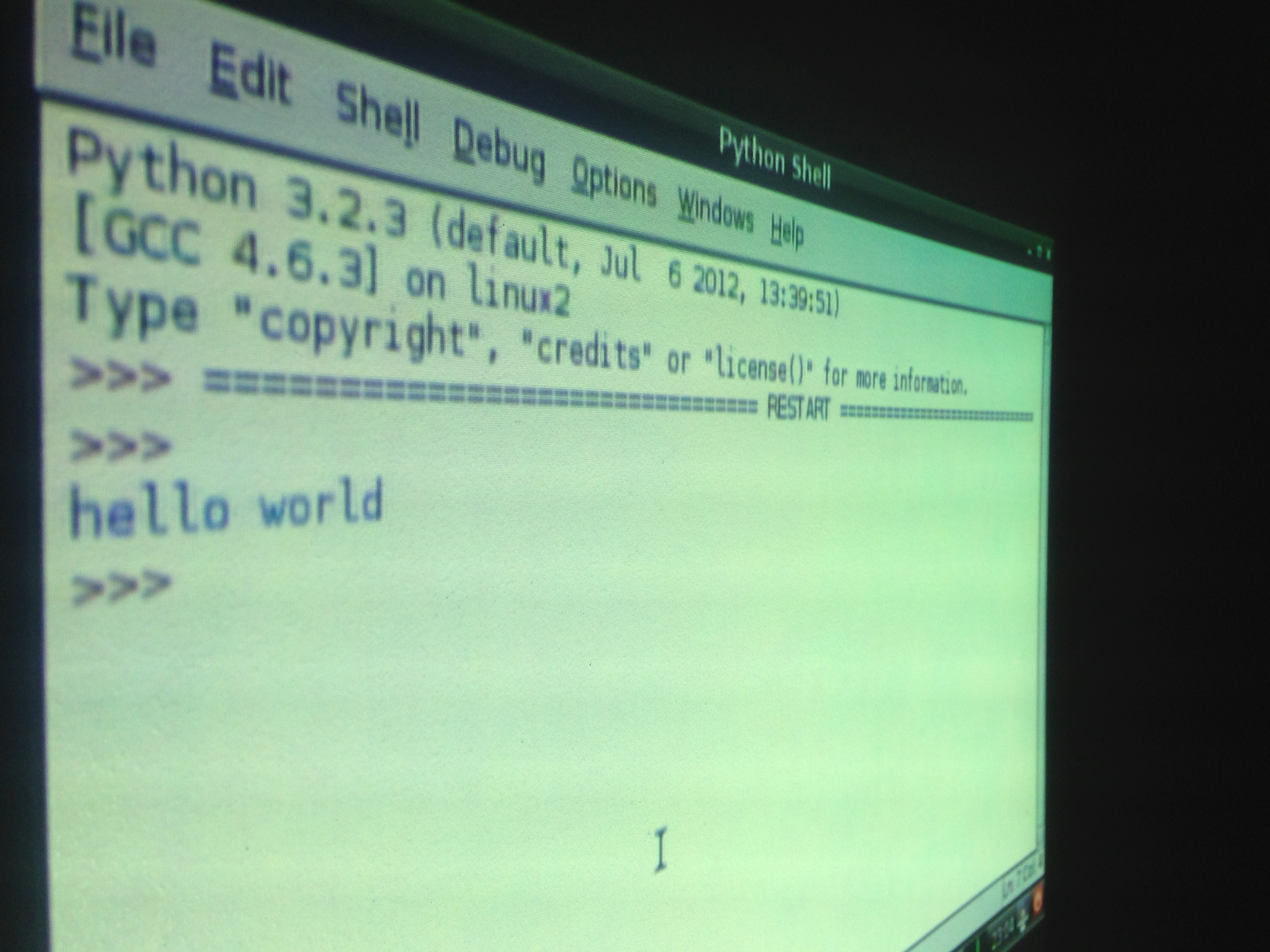
This week was the first time we got down and did some programming. Hence the photo at the top of this post! We are going to be using Python (of course!) as the language of choice.

The resources I am using are:

Python Resources

I also plan to teach Python to Year 8 and 9 after Easter . 

ICT/Computing Projects 2012-2013 – Initial Thoughts Pt 1

Keyboard

It is only January and I am already thinking about next year.  The job of a Head of ICT is never done! 😉

However, before I think about new projects for next year I want to release version 1.1 of Mr Britland’s ICT Curriculum. I am aim to have this done by February. The plan is to add the following:

  • Curriculum Strands

Digital Literacy
Digital Citizenship
Digital Creativity
Computer (Digital) Science

  • Aims

Keep an eye on my blog for the new update.

So? What about next year? Well…at the moment as an initial thought I would like to add a new project. This will be on Computer Networks.

At the moment I teach my year 8 students about computer hardware, key British Computer Scientists and touch upon the four generations of computers. Next year I would like to deliver this to Year 7 and teach Computer Networks to Year 8.

Next blog post coming soon with some more ideas for next year.

My Skype Interview with Game to Learn

Check out out the Game to Learn Facebook group and YouTube Channel for more interviews and other good stuff.

Being an outstanding teacher relies on more than passing harder QTS tests

This blog was originally published by The Guardian on 12th November 2012.

The government recently announced its latest change to the teacher training programme: in order to make entry into teaching more challenging they will make the QTS skills tests more difficult by raising the pass grade over the next three years.

In order to pass, candidates will need to score the equivalent of a B at GCSE to pass. The government is also hoping to attract high achieving computer scientists into teaching by offering £20,000 scholarships. Yes we need high flying graduates if they have the correct skills to teach. However, a degree from a Russell Group university or an outstanding academic record isn’t simply a passport to good teaching.

When I took my GCSEs (nearly 20 years ago) I ‘only’ achieved a C in English and maths. Does this mean someone who achieved an A* or an A would be a better teacher? Of course not. Raising the minimum requirement to pass the QTS skills test to the equivalent of a B will not improve the quality of teaching, but only prevents potentially outstanding teachers from entering the profession.

It seems like another misguided step from Michael Gove, the education secretary, and shows he understands little about what is required to teach. It is also very shortsighted to think that the standard of teaching will improve because these tests are harder to pass.

In all honesty, why do we have a system that includes skills tests in the first place? If the prerequisite for entry onto a PGCE course includes GCSEs in both English and maths (and science if in primary training) then surely that is a better indication of your ability? Why the need for both?

During my career I have worked and trained with people who, on paper, are far more qualified than me, including the academically gifted and experienced industry professionals. Many of these people have entered the profession under the impression that qualifications, and being considered a ‘high flyer’ in their industry, will mean they will be a great teacher. Inevitably it’s a shock when they start training.

I have also seen many people who, according to their qualifications, should be outstanding, but have dropped out during their training year, failed to complete their NQT year or struggled to get teaching jobs. Why? Because it turns out, there is more to teaching than having a list of qualifications as long as your arm or how successful you are in a chosen industry. More should be made of the other qualities teachers require, that dare I say, are more important.

What qualities make an outstanding teacher?

I tweeted the following question to my followers on Twitter: “What are the most important things to look for in those wanting to train as teachers?”
I really wanted to know what other teachers around the country thought. Was I being naive in thinking that Gove was taking the wrong approach, that raising standards is as easy as raising the minimum qualifications required to train?

Below are some of the qualities I took from the Twitter response:

• The ability to build relationships, passion, a desire for learning, flexibility and being able to adapt.

• The need to enjoy working with young people and have an idea of what a career in teaching entails.

• A sense of humour in trainee teachers and the ability to see past labels.

• The ability to inspire, treat learners like equals and see the potential in all students. Teachers need to be positive, optimistic and confident.

One person tweeted that adaptability was more important than qualifications, which I thought was a great point. Not one person mentioned that trainee teachers need to be highly qualified.

The hypocrisy of Gove’s mission to improve the standard of new teachers is that academies can employ people who do not even have a formal teaching qualification to teach. On one hand Gove is saying how important it is that we only allow people to teach who have the best qualifications, and on the other hand that actually, it doesn’t matter, employ who you like.

Raising the standards of teaching is very important and I am all for it. However, we cannot lose sight of the other qualities required to teach, over and above just teachers’ qualifications.

Facebook Privacy Settings – Teach your students

Facebook Privacy Setting

A photo of Facebook privacy settings, during todays lesson.

After talking to the many students I teach, it is very clear that the majority do not seem to understand the Privacy setting on Facebook. This is obviously a massive concern, due to the sheer numbers of students across the country/world on Facebook.

I decided to remedy the situation during my year 9/3rd year project ‘Your Digital World‘.

For 15 – 20 minutes (however long it takes) at the beginning of each lesson this week, I gave students a tour of the Facebook privacy and profile settings. Some students knew some of the settings, but I would say the majority knew very little.

Students got really involved and asked plenty of questions. At the end of every lesson I have taught, they had said they were going to change the settings as soon as they got home.

I would encourage all schools to teach this information to their students and staff, if they do not already.

If you school/IT department block Facebook, ask them to unblock it for staff (students even) so they can deliver this important information. Even if it is only for the duration of the lessons.

I would love to hear from other schools doing something similar. I am particually interested in hearing from those at schools who will not unfilter Facebook, even for a lesson so that you can teach about the privacy settings.