Technology

Mr Britland’s Open Source KS3 Computing Curriculum V3: 2014-2015

{UPDATED}

I have been working very hard over the last few months producing my new Computing curriculum and it is finally ready.

Details below:

Feel free to download and use this curriculum. If you use this booklet, its projects or ideas and would like to make a donation for its continuing development, please use the link provided. I would like to keep giving this document away for free so any donation would be amazing. Please click to be redirected to my donation page.

This is now version 2 – DOWNLOAD HERE

V2

I have added / amended the following:

  • Amended strand descriptors.
  • Added a new ‘How to use this Booklet’ section
  • New section on what software and websites are used, including free alternatives to paid software
  • Amended ‘Visual Programming: Kodu’ (Year 7)
  • ‘Computer Hardware/History’ project now called ‘How a computer works/computing history’ and now includes software. It is now taught in Year 7
  • Added ‘The Web: HTML5 and CSS3’ (Year 8)
  • Added ‘Networks’ (Year 8)
  • Added ‘Google and Algorithms’ (Year 9)

End products have changed for the following projects:

  • Stay Safe Online – Online guide using Snapguide
  • Visual Programming: Kodu – Screencast using Screenr
  • Your Digital World – Online presentation using slide.es

In Development

  • New creative projects
  • How to use an iPad to teach this curriculum

If you would like some help with creating your own resources or would like me to produce any educational publications, please visit www.realiselearning.co.uk.

(New Projects Part 10) Visual Programming: Kodu – 1st Year/Year 7

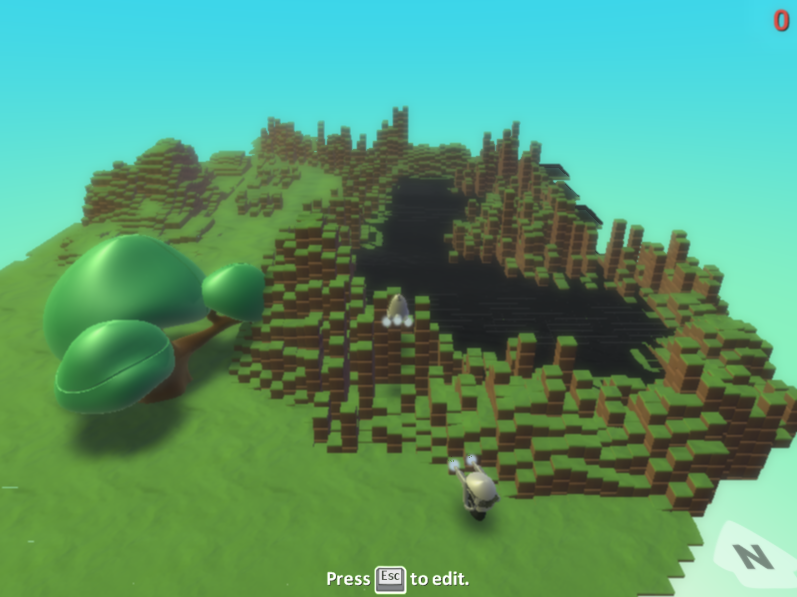
This projects is an introduction to programming fundamentals using MS Kodu. Students learn how to create their own video games and get some idea how they are produced in the industry.

Project: Visual Programming: Kodu

Project Sheet (link)

Presentation (link)

(New Projects Part 9) Staying Safe Online – 1st Year/Year 7

This is the 1st online safety unit students have in ICT.

In this project student will use www.thinkuknow.co.uk to learn about staying safe online and then produce an interactive kiosk style publication for other students.

Project: Staying Safe Online

Project Sheet (link)

Presentation (link)

iPad Trial 2012-2013 – A few initial notes

iPad

A few notes I have put together with some thoughts of how I will implement the iPad trial in September.

We are looking at buying a class of iPads initially and then taking it from there.

Leading up to September:

  • Buy iPads from reseller
    • Check they will help with the set up. Decent ones will
    • Do we get protective covers?
    • What charging solution?
    • Which reseller?
  • Get a Mac set up for iTunes
  • Think about the Apps we would like to buy
  • Buy an adapter so we can mirror iPad on the board
    • Can we do this for the inset?
    • Is the projector wireless
    • Buy an Apple TV? Could be a winner? Check it works on the wireless. Again…reseller could help with this.
    • http://www.youtube.com/watch?v=Dy7Q2vrU7uI
    • Would be great for Skype or FaceTime
      • Could use an adapter instead…but it is not wireless.
  • Plan the inset – could be done after the initial 1st day.
  • Produce training resources for staff
  • Set up DropBox account
    • 1 per students?
    • Per class?
    • 1 for the school
  • Email Address?
    • Email for each iPad?
    • Will not be workable in the trail for students having to put in their own school address all the time
  • Do the apps we want to use work on the network?
    • Edmodo
    • Socrative
    • Evernote
  • Create some digital resources
    • iBooks?
    • PDF?
    • Convert some department resources and make available on iPad/DropBox

Trial

  • Show departments some example projects
  • Departments can then bid for the class set
    • Come up with their own ideas
  • Department should have some trial iPads to play with.
    • 1 per department?
  • Each department will have a champion
    • They will be trained.
    • They will train the other members if their departments
    • Ideally they will volunteer.
  • All “champions” will attend meetings
    • Successes
    • Problems
    • Ideas
  • Every class member will be allocated a iPad
    • They must have the same one for the length of the trial
    • Sign out sheet
      • They will need to tic the iPads out
  • Evaluation process for each project
  • Final evaluation for whole trial

Things to consider

  • Make projects creatives, engaging and relevant.
  • We need to use them for the more “boring” projects too
  • How will we manage the classroom?
  • How long will the trail go on for?
    • Till Easter? This will give us time to properly evaluate?
  • What do we want the outcomes to be?
  • If the trial is a success do we buy more?
    • 1:1?
  • If it does not work, what will we do to make sure it does
  • Parents open evening
    • Show what we have been doing
    • Get them involved and engaged.
    • Keep them in the loop
  • Share training videos on iTunes U?
  • If we create some lesson videos, ebooks, audio podcast we can share them too.

Plan for Year 7/1st Year ICT – Sept 2012-2013

Every year since I started teaching I have re-written schemes of work. It is not that they were not good enough when I first wrote them (although I am sure some were not up to scratch) its just that ICT moves so quickly.

Next year I have some great ideas how to mix up the curriculum and take into account the current trends in digital education.

I will be taking some of what I have been doing this year and expanding on it.

This blog post will not be massively detailed, but will include some brief notes on what I intend to teach year 7/1st years come September.

Autumn Term

During the Spring term this year my 1st years created blogs using Edublogs to blog about how young people can stay safe online. This worked out brilliantly and the students loved it, even those who do not enjoy English. Not only did it teach students how to safe safe online but it could also be used by other to learn from.

This year I am going to get my students to create a learning blog during the first few weeks. The plan is that they will update this every lesson and document what they have learnt, rather than just using it for the stay safe online project. They can then take this blog with them throughout their time in KS3 and even KS4/5 if they choose. Hopefully, after a few weeks adding a blog entry will become second nature and they will not need reminding.

1st Half Term

  • Setting up student blogs
  • Searching the internet

This will be ran by at the beginning of term and will be delivered by the new learning resource manager/librarian. It will also teach students  how to use the library system.

Office Applications/Cloud office applications (Google docs)

I know many believe that all student know how to use office applications from birth, unfortunately they dont. There is a difference between being proficient and stumbling through the application. In order to make sure students know how to be productive users of office applications I will spend several weeks going through these applications.

As well as the usual MS Office application, students will also sign up to the Google Docs application. I want my students to be aware that there are other alternatives as well as teaching them about cloud computing. Why use the cloud? What are the pros and cons etc. Students can then decide which tools they use themselves.

Second Half term

  • Continue with the office Applications/Cloud office applications

For a few weeks after half term we will continue with this project.

  • The Digital World and how to stay safe

I have not quite decided what form this will take. Last year we used a blog to document what we had learnt. As we will be adding blog entries every lesson I would like to do something different. Perhaps an e-book? I want to do something exciting, engaging and immersive. I may use iPads to get the students to work in groups and create a video in iMovie. We can then put the video on our school website.

Essentially, in this projects students will learn about social networks. What they are, pros and cons and how to stay safe using them. We will also cover all other aspects of staying safe in a digital world. The thinkuknow website is a great resource. I would also advise everyone to go on the CEOP training courses, they are brilliant.

Spring Term

  • Game Design using Kodu

Kodu has been such a success this year that I am going to stick with the same format. This time I am going to buy 28 XBox controllers and turn my classroom into a games studio. It’s going to be awesome.

I will also go more in-depth into how real video games are design/created and talk about Unreal Engine and CryENGINE.

In the future I would also like to start to use UDK (Unreal Development Kit), just need to find time to learn how to use it.

Kodu Scheme of Work

Kodu Video Tutorials

Summer Term

I did App design with my 1st years this year. However, this was coming up with ideas for Apps and then designing them and creating screen mock ups using Adobe Fireworks. It was great and the students loved it and learnt a lot about Apps, smartphones and tablets. This year I want to take it to the next level and use App Inventor.

I have looked at this before, but did not get around to learning how to use it for one reason or another. During this term I went to an old colleagues house (@alecwaters) and he showed me it in action and I was suitably impressed. My kids are going to love it. I still intend to do all the planning and mock ups but this time actually create the App.

What I have to do

  • Write new schemes of work/learning
  • Buy Xbox controllers (I have one)
  • Buy some cheap Android handsets

Once I have written my new schemes of work I shall post it on my blog.

I hope you like what I have lined up for my students next year. If you have any questions let me know.

Is it time to rebrand ICT?

This blog was originally published by The Guardian on 30th May 2012 and is an update of a previous post on this blog.

When I did my GTP several years ago I did next to no training in computing. As we all know the curriculum was very much ICT-based and that was fine with me. The skills I have very much fitted in with the curriculum I had to teach.

Things are now changing. Gove has told teachers that they don’t have to stick to the old curriculum. Over the past year and a half I have been able to teach my own curriculum anyway, as I have moved to an independent school. But it has been made very clear there is a need to teach computing in schools before KS4.

I agree this should happen, and it’s very exciting. However, it is also quite intimidating. I have spent almost seven years (including my training) teaching ICT with very little computing. Where do I go from here? Well, I have already started teaching visual programming usingKodu. I am also in the middle of writing a computer science scheme of work to be delivered next year. This will teach students how computers, smartphones and tablets work.

Is this enough? Like many ICT teachers I do not have a lot of curriculum time compared to other subjects. It would be a shame if state schools were forced to drop ICT and only deliver computing because of a lack of time. In fact, we would be doing our students a disservice.

Like many others I need guidance.

My biggest worry is programming. The reason I didn’t choose programming at university was because I find it very difficult. For me it is like learning a new language. I am very much of the opinion programming is not for everyone. Although, I understand it is very important.

I am sure there are other teachers like me who do not program. If the government want programming in schools they are going to need to stump up some money for training courses.

There is a danger that if teachers need retraining, courses will be supplied by large corporations like Microsoft or Google. Can we trust them to give teachers the training they need or will they simply take the money and create training that directly benefits them?

However, over the last few weeks I have been using Codecademy to learn Java Script and to become more proficient in HTML and CSS. This is free and has been fantastic. Hopefully, this will allow me to deliver more programming next year. Perhaps we do not need to pay for training and we can train ourselves?

If all students were taught to be programmers throughout their school lives would we find masses of them out of work? There are only so many jobs available. The people who will benefit the most will be those paid to write computing courses.

There has to be room for both ICT and computer science.

Students should able to choose between the two, certainly at KS4 or 5. After all students are able to choose which languages they learn or sciences they study.

We need both to be exciting and engaging. Teachers in different schools need to be sharing resources and schemes of work. Many are already, certainly the teachers I know. If we are to change the way ICT is perceived we need to be constantly evolving. If we want to incorporate computer science into schools we need innovative ways to teach it communicated to all.

Conferences like the Guardian Teacher Network’s Teaching Computer Science in Schools are important ways for people in education to get together and discuss what the future holds. These are great as long as teachers are allowed to get time out of school. I fear many may not.

I would also very much like to rebrand ICT, for me it is old fashioned. Perhaps “digital literacy” would be more appropriate?

There are several teachers who I follow on Twitter working on Digital Studies. Is that the rebrand we need? I don’t think there is one answer but I would certainly like to rebrand ICT at my school.

In conclusion, I am looking forward to including computer science into my curriculum. It is intimidating but a great opportunity for personal development. Now I must find the time to teach myself what I now must deliver. Finding the time in an already incredibly busy job may be toughest task of all.

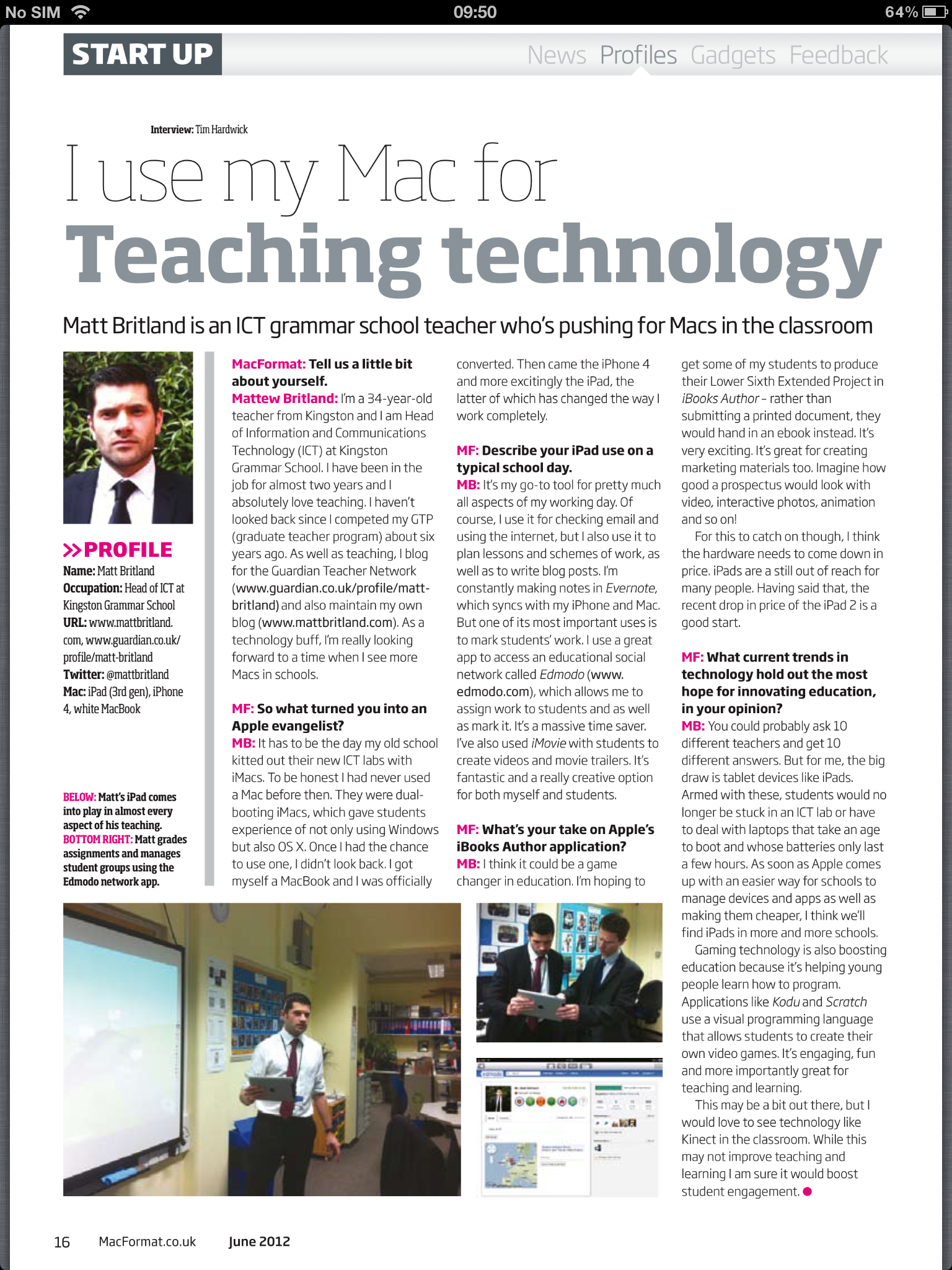
“I use my Mac for…” MacFormat Interview June 2012

iPad

I was lucky enough to do a very brief interview with MacFormat for this months magazine on what I use my Apple devices for.

Have a read below and I would also pick up the June edition as it has got some great stuff in.

Using Facebook Groups in Schools

In my experience students  have never been brilliant at checking their school emails, especially the older kids. This makes communicating with them quite difficult when they are not sat in your class.

A great way to improve this is to use Facebook groups. Now, this presents a problem. The main one being schools tend to be terrified of social networks. Possibly because they do not understand them? However, if you have a forward thinking school you can over come this by showing them how useful they can be. Once they are aware of this they may let you give Facebook groups/Twitter a go.

The reason I wanted to use Facebook groups is that many students check it everyday, more often than not several times a day. In fact, much of the time they are using their smartphones rather than a computer to access their profile. It Almost makes filtering Facebook in schools a bit pointless.

Facebook is a smarter, faster and more efficient way of communicating.

This is why I wanted to pilot the use of Facebook groups at school.

So how did we do it? Well, firstly and rightly so, the teachers (myself included) did not want to use their personal profile to set up groups.

This is what we did:

  1. Set up a school Facebook profile (using a separate email address)
    • The name would be the initials of the school then the teachers surname.
    • Once we had set that up we would go through all the privacy setting and make sure they were locked down. (Although the profile would essentially be blank and contain no personal information apart from maybe a profile picture of some variety)
  2. We would then add other school profiles (not personal profiles) as friends so we had a little network going.
  3. Create a private group. (Private groups mean others can see who is in the group, but not what is written in it)
    • To create a group you must add at least one person. Teachers added me as I was running the pilot.
  4. Once that has been done the owner of the group can then email the group URL to the students they would like to join. The students then make a request to join and the teacher can accept.

Doing it this way means that at no point does a teacher need to be “Friends” with the students and all communication is carried within the group.

The trial has been very successful and I have now got more teachers involved.  I have found using groups has:

  • Improved communication
  • Allowed teachers to share important information quickly
  • Share resources like videos and links quickly.
  • Carry out polls
  • Create documents
  • Embraced the technology students are using

We have set up Facebook groups mostly for extra curricular activities such as:

  • Sports
  • Duke of Edinburugh
  • Houses
  • School expeditions
  • Clubs

However we also set up accademic groups, which have also been sucessful.

Things to think about:

  • Ask permission from your school
  • Remember you need to be 13 to have a profile (I know students do have them when they are younger but they shouldn’t)
  • As a teachers and owner of the group you must remember to moderate all of the posts
  • Do not make “Friends” with students, even on a empty school profile.
  • If you are overseeing Facebook Groups make sure you make a list of all school groups. You really need to be aware of how many school groups you have.

I hope this has been useful. There are probably other alternatives to this method but this is the way I have used and it works very well.